Lisp Game Jam devlog: Polydraw
Dave Thompson, Christine Lemmer-Webber —This year's Autumn Lisp Game Jam has just wrapped up! Spritely's contribution to the jam was Polydraw, a peer-to-peer party game that is easy to pick up and play with friends. In Polydraw, players take turns being the artist who draws an image based on a prompt. The catch is that the artist only has 60 seconds and can only draw using triangles. All of the other players are guessers who try to correctly guess the prompt. We're quite pleased with how the game turned out!
The rest of this post is a daily devlog of how we made Polydraw so you can see what the process look likes to make a game with Goblins and Hoot under a tight deadline.
Day 1 (10/30)
It's go time! First, we created a Git repository on Codeberg and copied the Hoot game jam template into it.
Since the core activity in Polydraw is drawing triangles, the first thing Dave implemented was an interface for doing that on a canvas. This first version was crude and didn't include a color picker.
Day 2 and 3 (10/31 and 11/1)
We took the weekend off to prepare for a busy week ahead.
Day 4 (11/02)
This is the day that we really got to work on the game jam.
The first version of the triangle editor stored pixel coordinates of the local canvas, but that wasn't going to be good enough to display on other machines with different sized canvases. So, Dave simply normalized triangle vertices into the [0,1] range so each peer could scale them as needed.
Dave also implemented a basic scene system, a common game programming pattern, to encapsulate the coarse game states such as the title screen, the lobby, and the main game.
A color palette was added along with some additional mockup UI around the canvas.
Day 5 (11/03)
With a good enough game engine in place, we turned our attention to the game protocol. Since we are using Goblins, all interactions are modeled using actors. Dave came up with the following actors:
-
Player: Used for player identity within the game and contains the player's self-proposed name.
-
Lobby: The place where players gather before the game starts. The player that creates the lobby is the host and all other players are guests.
-
Game: Holds all of the game state like the player list, whose turn it is, and the scoreboard.
-
Controller: A player's virtual game controller. Used to speak to the game actor, but all actions are scoped to the individual player.
A test script was written to simulate creating a game, joining the lobby, and playing a round. At this stage, everything was happening in a single process. Goblins makes it easy to start with a single process and then distribute the actors to multiple machines later.
Day 6 (11/04)
Now it was time to get the actors onto the network and hook them up to the game UI. For networking we used OCapN, naturally. Jessica started up an instance of our new end-to-end encrypted relay netlayer that we set as the default relay so the game would "just work" when we uploaded it to itch.io. In fact, dogfooding the relay was a large part of the motivation behind participating in the game jam in the first place!
Dave got the actors online with OCapN and connected the game UI to the actors, then confirmed that a three player game works. Three players is the minimum number of players needed to trigger OCapN's third-party handoff feature. Handoffs are what enable distributed networking in OCapN: Alice can give Bob a reference to Carol, which causes Bob and Carol to establish a new OCapN session with each other. This is the first application we've made that does handoffs over the relay netlayer and it was nice to see them working as intended.
Unfortunately, we discovered an issue with how Goblins handles two peers connecting to each other concurrently, a problem known as "crossed hellos". OCapN mandates that only one connection may be open between any two peers, so we have to pick which connection wins. The bug is that any promises that were created over the losing connection never resolve. This was observed in the game as an empty lobby player list that should be populated. It didn't prevent the rest of the game from working, though, so we didn't try to fix it (yet).
Day 7 (11/05)
On this day, Dave discovered that, despite his best efforts, he fell
victim to the "identity footgun". We could write a whole blog post
series about the many subtle issues of object identity (in the sense
of Scheme's eq?) in object capability systems, but instead we'll
refer you to the The Grant Matcher
Puzzle
and just mention that using object references as keys in associative
data structures is error-prone. A promise that eventually resolves to
a reference to Alice is not identical (again, in the eq? sense) to
a reference to Alice. So, if you accidentally use a promise as a key
somewhere or use eq? directly you will probably have a bad time,
which is exactly what happened to us.
To deal with this identity crisis, Dave first detected it at runtime
by writing a
wrapper
around eq? called geq?. This new predicate throws an error when
comparing a promise to a non-promise. Then he used the resulting
backtraces to find the offending code and change it to resolve all
necessary promises before doing identity comparisons.
Christine finally cleared enough other things off her plate where she could start contributing to the game. We thought it would be nice to have the game start with a splash screen of triangle'y animations that would resemble the kinds of art players would make in the game. We decided to use the Blender add-on by Ursula Kurdali named Stop Motion since it gives a great amount of freedom to animate by creating and destroying as much geometry as you like. Christine made the first mockup of a splash screen animation of a "death" type character swinging a scythe.
However, the animation hadn't left Blender yet. We're gonna have to figure out how to get those polygons out and into the game engine!
Day 8 (11/06)
This was the day to finish implementing the core game loop. We wanted the weekend to be all about fixing bugs and making it look and feel as good as we can. At last, the points awarded at the end of each round were displayed in the UI. The player list on the left side of the screen was transformed into a leaderboard that sorted players by score.
While creating the leaderboard it was discovered that Goblins was not correctly parsing pairs received over OCapN. Christine swooped in with a quick fix and Jessica folowed up with a regression test.
We also added a small set of emoji reactions underneath the leaderboard. Reactions were not critical to the core gameplay but they were planned from the very beginning of the project. It's good that we had time to add them because it was a lot of fun to spam emojis at the artist to give them an indication of how good or bad they were doing.
Day 9 (11/07)
With two days left and the core gameplay loop complete, the focus shifted to bug fixing and adding juice. Up until this point the HTML was mostly unstyled (as you can see in the videos above), so Dave added a little CSS to improve the look and feel.
A playtest revealed that the simple PRNG we were using was implemented incorrectly. We noticed because the artist prompt was always "bus" no matter how many rounds you played. Oops! This was fixed.
Remember that crossed hellos bug from day 7? Dave finally implemented a workaround, which was to simply throw out the first pancake and try again, as suggested by Christine. A simple race against a timeout was all that was needed. We'll be thinking about how to fix this in Goblins so this situation cannot happen in the future.
Christine started work on making more animations for the game's intro. The "death" animation was a good "hello world" for testing the exporter, but being all black it was too simple to make sure everything worked right; draw order, etc, didn't matter. Christine made a "square guys" animation as a kind of Acid2 test equivalent. This file had several tricky properties to it, most especially that draw order would matter, colors would be important, et cetera.
Christine also made this triangle'y duck themed piece:
Christine wrote a Python script to export the animations from Blender into a custom format encoded using Syrup. The encoded data was then embedded into the Scheme program as bytevector literals using a little script. Dave then started work on a renderer for these animations, but it wasn't working quite well enough by the end of the day to commit and push it.
Up until this point we only had a small number of frequently-repeated words. Morgan Lemmer-Webber curated a word list for us, starting with an existing public domain word list of 5000 words, and curated down to a 621 words, selecting for words that were more feasible to draw (ranging from easy to challenging, but all trying to be feasible).
The game name was changed from the placeholder "Twenty Triangles" to "Polydraw".
Day 10 (11/08)
The final day.
The code to render animations was finished. Some final minor bug fixes were made. Some CSS was tweaked. Original music and sound effects by encrypted.whispers were added. Additionally, we used a few CC0-licensed sound effects by Kenney.
A few gameplay improvements were made, such as showing guessers what the prompt was when the round ends and how many triangles the artist had remaining. Little improvements can make a big difference and both of these changes were very helpful for players and made the game feel more polished.
There wasn't enough time remaining to do as much work on resiliency in the face of network partitions as we would have liked, but Dave did squeeze in a commit that allowed the game to survive if a guest leaves. Unfortunately, the experience for the disconnected guest isn't very good as they don't see any message that their connection dropped.
We did a final playtest to confirm that there weren't any showstopper bugs. Christine added final splash animations.
Finally, Christine added some code (fixed up by Dave) and animations which would overlay over the drawings indicating that drawing was starting, it was time to guess, or the results.
Pencils down!
We submitted the game two hours before the deadline! Now it was time to catch our breath and show off the game to everyone we could. Dave even played it live with a couple other people on a stream! Here's a screenshot which gives you a good look of the final result:
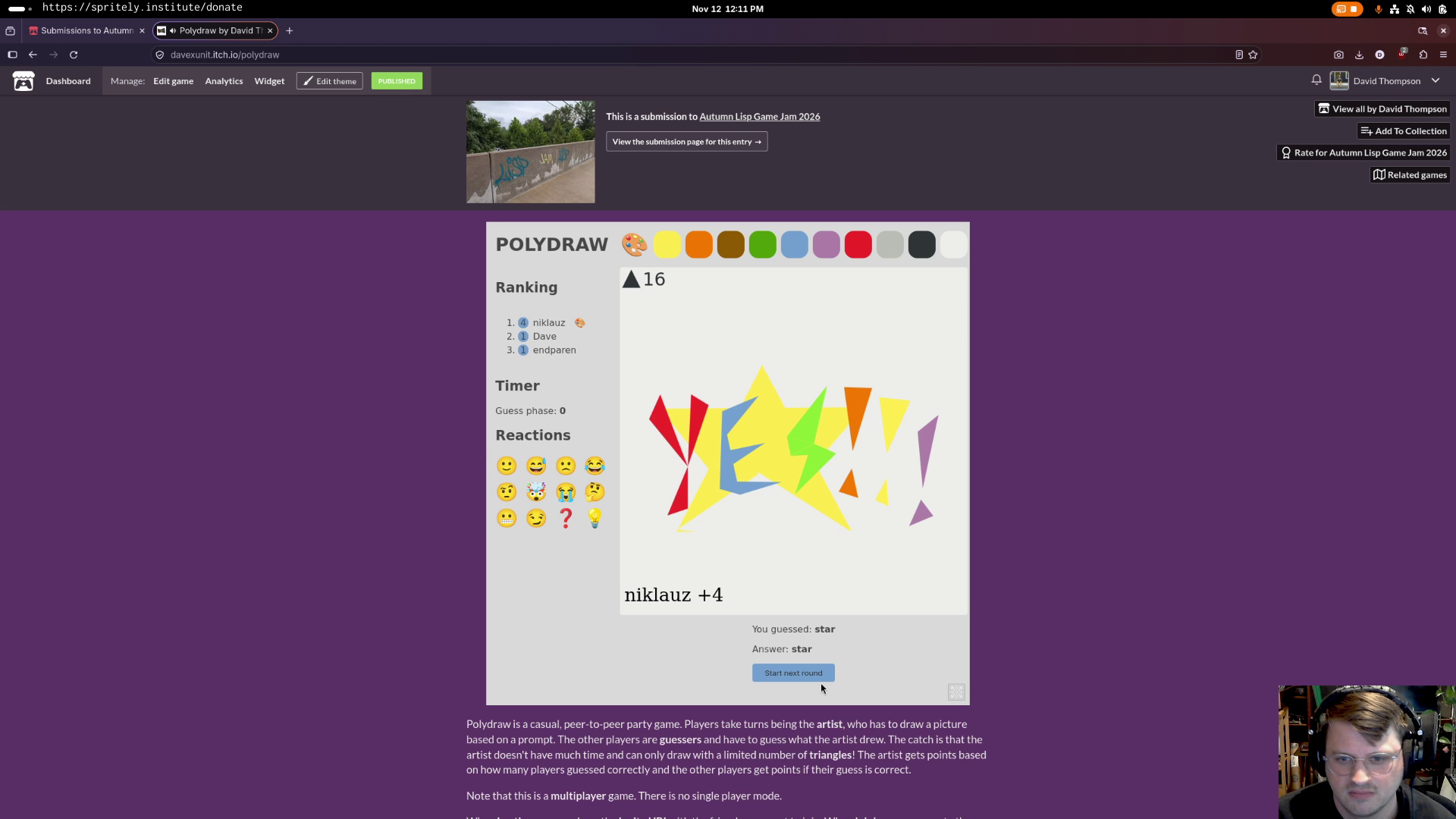
The response was quite positive! The feedback we received closely matched the things we wanted to improve upon if we had more time: better disconnect handling, a way for the host to skip to the next phase instead of being forced to wait for the timer to run out, and invite URLs (rather than URIs) that auto-join the game when visited.
Polydraw ranked 5th overall in the official game jam results.
Try playing it over on itch.io and leave us a comment!
Thanks to our supporters
Your support makes our work possible! If you like what we do, please consider becoming a Spritely supporter today!
Diamond tier
- Aeva Palecek
- David Anderson
- Holmes Wilson
- Jonathan Frederickson
- Lassi Kiuru
Gold tier
- Alex Sassmannshausen
- Juan Lizarraga Cubillos
- Nerine Pekowsky
- Serra Allgood
Silver tier
- Austin Robinson
- Brit Butler
- Charlie McMackin
- Dan Connolly
- Deb Nicholson
- Diana Thayer
- Eric Bavier
- Eric Schultz
- Evangelo Stavro Prodromou
- Evgeni Ku
- Glenn Thompson
- James Luke
- Jonathan Smith
- Jonathan Wright
- Justin Sheehy
- Matt Panhans
- Michel Lind
- Mike Ledoux
- Nathan TeBlunthuis
- Nia Bickford
- Noah Beasley
- Steve Sprang
- Travis Smith
Bronze tier
- Alan Zimmerman
- Aria Stewart
- Ben Hamill
- Benjamin Grimm-Lebsanft
- Brooke Vibber
- Brooklyn Zelenka
- Carl A
- Crazypedia No
- Ellie High
- Elliot Martin
- François Joulaud
- Gabor Udvari
- Grant Gould
- Gregory Buhtz
- Ivan Sagalaev
- James Smith
- Jason Wodicka
- Jeff Forcier
- Marty McGuire
- Mason DeVries
- Michael Orbinpost
- Neil Brudnak
- Nelson Pavlosky
- Nicholas Farley
- Philipp Nassua
- Rodion Goritskov
- Ron Welch
- Stefan Magdalinski
- Stephen Herrick
- Steven De Herdt
- Tamara Schmitz
- Thomas Talbot
- William Murphy
- Yoshua Wakeham
- a b
- chee rabbits
- r g
- terra tauri